
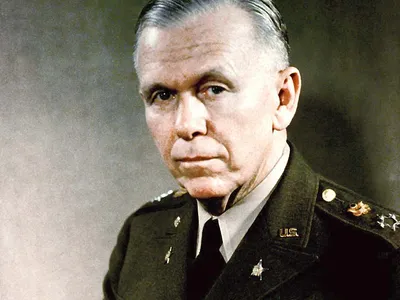
A modern-day Cincinnatus who guided a nation through its greatest trial, then walked away from the honors he had every right to claim.
or over two thousand years, the name of Lucius Quinctius Cincinnatus has stood for outstanding leadership in time of war, service to the State, civic virtue, and the ability to turn and walk away from all honors of the populace and State, knowing that one has done one’s duty. George Washington was and is often referred to as a colonial Cincinnatus for his thoughtful deliberation on setting precedents for our nation, his service, and his shunning of great honors and titles.
I believe, after reading this third volume of Pogue’s massive biography of Marshall, that he too was a modern-day Cincinnatus. Offered foreign titles and national acclaim, a huge sum for his memoirs (in 1947 he was offered a minimum of one million dollars for a book, equal to over eleven million today) which he refused, he guided the United States military through the dangerous times of the Second World War.
He was able to work with the President, Congress, the struggles between the armed services, and the pressures from such a great man as Churchill and the not so easy to work with DeGaulle, to mobilize, equip, train, and pick the top officers who would take the United States from an army of less than 200,000 to a force of nearly 9,000,000 in just over two years.
A Man Above Politics
Showing loyalty to the President and with a clear understanding of his duties to the Congress, Marshall stood above politics. He could be heartless in demoting career officers who could not adjust to the stresses of modern warfare, while he had the utmost concern for the morale and well being of the average soldier.
He had seen from prior wars the high cost of favoritism and was determined that the American soldier would not be wasted due to political or personal contacts.
A visionary, he grasped the key to victory as control of the air, and pushed many officers out of the service who could not understand this direction. When contacted by old friends and fellow officers for special favors, he would in most cases tell them that he could not help unless an officer was asking for posting to a more dangerous position.
The Verdict
I came away with a deeper admiration for Marshall and a bit of sadness as I view the exact opposite actions by many of our politicians. Marshall retired to a quiet life and, unlike some of our former Presidents or current leaders in Congress, did not exit public service a millionaire many times over.
This can be a difficult book to read in that the detail is tremendous and may be difficult for anyone not conversant with the historical timeframe. Yet I looked forward to the book each time I picked it up. I would recommend this book to anyone who wishes to seriously understand the importance of a modern-day Cincinnatus.